Biology Made Doable™ Is Changing the Purpose of Reading Assignments
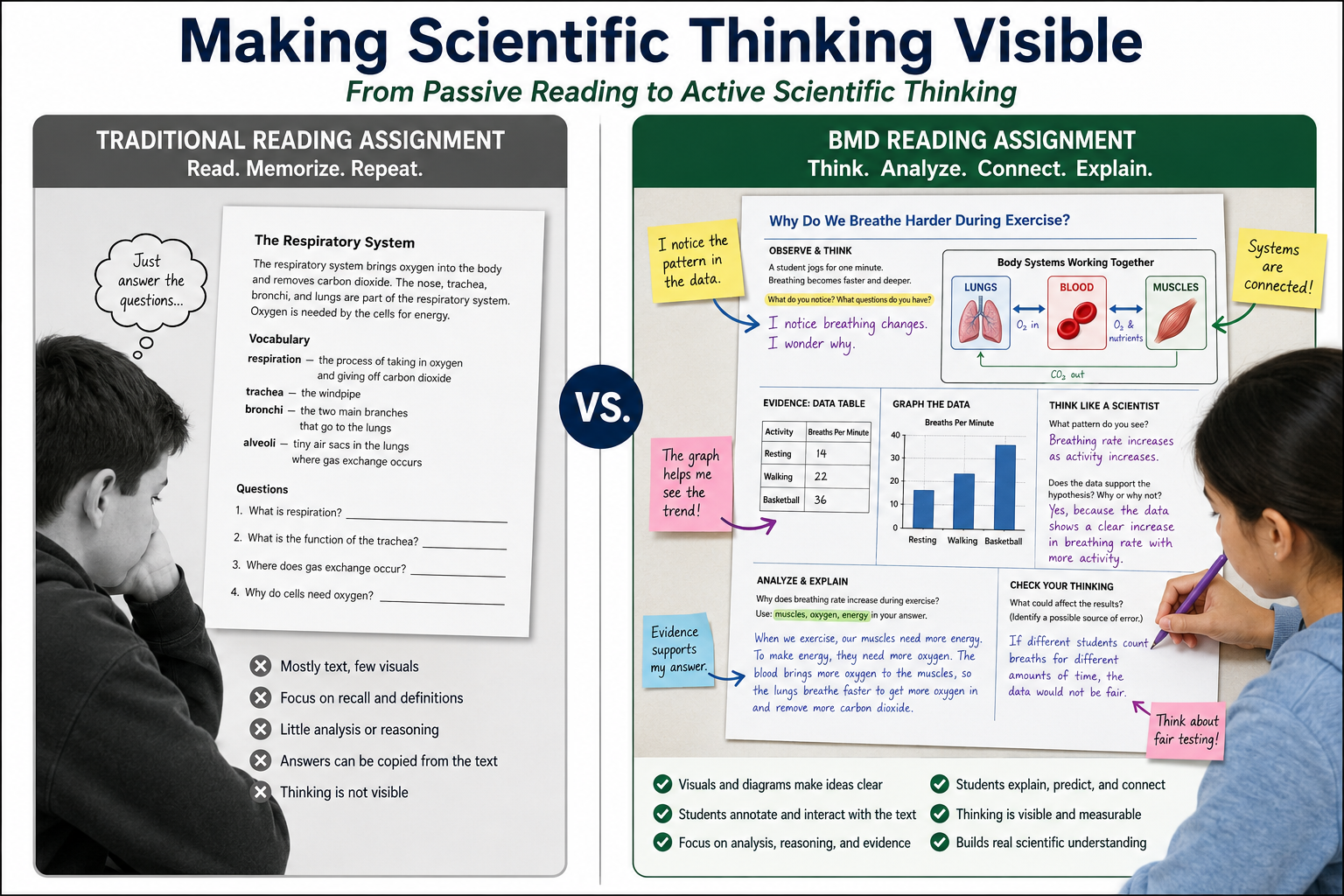
Biology Made Doable™ is evolving beyond traditional science worksheets. Our new reading assignments are designed to train scientific thinking through evidence, systems reasoning, graph analysis, prediction, and cause-and-effect explanations — while remaining visually accessible and student-friendly. We believe rigor should come from deep thinking, not cognitive overload.
For years, many science reading assignments followed the same pattern:
Read the page.
Answer the questions.
Memorize the vocabulary.
But that approach often creates a problem:
students may finish the assignment without ever truly thinking scientifically.
At Biology Made Doable™, our reading assignments are evolving into something much bigger.
They are becoming tools for scientific thinking training.
We are designing lessons that make student thinking visible.
That means students are not simply copying definitions or hunting for answers in a paragraph. Instead, students are asked to:
• annotate their thinking
• interpret diagrams
• explain cause-and-effect relationships
• analyze evidence
• make predictions
• identify misconceptions
• compare ideas
• connect systems together
• and explain scientific reasoning in writing
This is where BMD is evolving now.
One of the biggest goals in Biology Made Doable™ is creating rigor without cognitive overload.
A reading assignment can be:
• visually accessible,
• scaffolded,
• student-friendly,
while still demanding:
• analysis,
• evidence use,
• comparison,
• prediction,
• cause/effect reasoning,
• and error detection.
That is real scientific rigor.
In our classrooms, students are increasingly being asked to think like scientists rather than simply memorize biology facts.
For example, students may:
• distinguish observations from inferences,
• evaluate whether an experiment is fair,
• identify variables and sources of error,
• interpret data patterns from graphs,
• explain how body systems interact during exercise,
• or determine whether evidence actually supports a conclusion.
The goal is not to make biology “easier.”
The goal is to make scientific thinking more visible, more teachable, and more achievable for a wider range of students.
Biology Made Doable™ is increasingly becoming:
scientific thinking training disguised as biology.
And honestly, we think that is exactly what modern science education should be.

Finish What You Start
Why Completion Is Both a Teaching Practice and a Moral Stance
There is a quiet reality in many classrooms:
students don’t finish what they start — and neither do the courses.
Units get cut short.
Projects are abandoned.
Concepts are introduced but never grounded.
And then everyone moves on.
It’s so common that it’s rarely questioned.
But it should be.
The Hidden Cost of “We Ran Out of Time”
When learning is routinely interrupted or abandoned, students absorb an unintended lesson:
“School doesn’t expect me to finish.”
Over time, this leads students to:
disengage halfway through tasks
invest only partially
wait for the reset that comes with the next unit
This isn’t laziness.
It’s learned behavior.
A Moment That Changed My Practice
I remember one moment clearly.
A student — who had been struggling earlier in the year — was finally gaining traction.
He was working through a unit, staying focused, and for the first time, you could see confidence starting to build.
The plan had been to move him into the next unit with the rest of the class to “catch him up.”
When I told him, he didn’t get relieved.
He got upset.
He looked at me and said, in his own way, that he wanted to finish it.
Not skip ahead.
Not start something new.
Finish.
That was the moment it clicked.
He wasn’t behind.
He was finally engaged.
Cutting that off wouldn’t help him catch up.
It would undo the very thing we had been trying to build.
So, I told him:
“Don’t worry about catching up.
You keep going.
You finish this.
I’ll work with you.
You’re right where you need to be.”
He stayed with it.
And he finished.
That moment reshaped how I think about pacing.
Pace Is Not the Same as Progress
In many classrooms, pace is externally imposed:
day-by-day calendars
coverage goals
collective timelines
Teachers feel pressure to keep moving — even when students aren’t ready.
But moving forward is not the same as making progress.
In the Biology Made Doable™ pilot classrooms, something different is happening.
Students are not being dragged forward as a group. They are working toward clear endpoints—and finishing.
Completion rates increased alongside passing rates, with the large majority of students completing units and earning credit.
Not because the content was easier.
Because the design was clearer.
Clarity Accelerates Completion
Students don’t stall because they are slow.
They stall because they are confused.
When learning is designed with:
clear instructions
predictable structures
logical sequencing
visible end points
students stop wasting energy figuring out what they’re supposed to do.
That energy shifts toward doing the work.
And when students work independently within a clear system, many of them actually move faster, not slower.
What “Finish What You Start” Looks Like in Biology Made Doable™
This principle is built into the structure of every module:
fewer, higher-quality tasks instead of endless assignments
complete modules, not half-finished projects
clear end points students can see from the beginning
built-in success criteria so students know when they’re done
Students aren’t guessing whether they’re finished.
They know.
Completion Builds Identity
Completion doesn’t just build knowledge.
It builds identity.
“I can do this.”
“I finish hard things.”
For many students, that belief is fragile.
And school often erodes it—unintentionally—through constant interruption, confusion, and unfinished work.
Completion restores it.
Not through praise.
Not through pressure.
Through experience.
Why This Creates Tension in Traditional Systems
Allowing students to work toward completion at their own pace can feel uncomfortable in systems built on uniform timelines.
Teachers are often expected to:
follow the same pacing guide
stay aligned with other classrooms
move through content at the same time
This expectation is often based on a practical concern:
if a student transfers between classes, the transition should be smooth.
That intention makes sense.
But in practice, it can create a deeper problem.
When pacing becomes the priority, instruction can shift toward:
covering topics quickly rather than building understanding
moving on before concepts are stable
prioritizing alignment over continuity
The result is not always smoother transitions.
It can lead to:
fragmented understanding
inconsistent retention
students who have “seen” content but cannot use it
In these situations, students may technically be on the same unit—but not on the same level of understanding.
Biology Made Doable™ takes a different approach.
Instead of aligning by calendar, it aligns by completion and understanding.
Because a student who has truly finished a concept — even at a different pace — is far better prepared than a student who has only been exposed to it.
Finishing well is not inefficiency.
It is instructional responsibility.
This Is Not About Lowering Expectations
Students in Biology Made Doable™ are still expected to:
complete the work
meet learning goals
demonstrate understanding
The difference is that the work is designed to be completable.
That is not watering down content.
That is respecting learners.
A Final Question Worth Asking
Before moving on, it’s worth asking:
Did students have a fair chance to finish?
If the answer is no, the problem isn’t student motivation.
It’s design.
Biology Made Doable™ takes a clear stand:
Learning should end with completion — not interruption.
That’s how confidence is built.
That’s how understanding stabilizes.
And that’s how students learn to finish what they start.
Why Biology Doesn’t Need to Be Encyclopedic
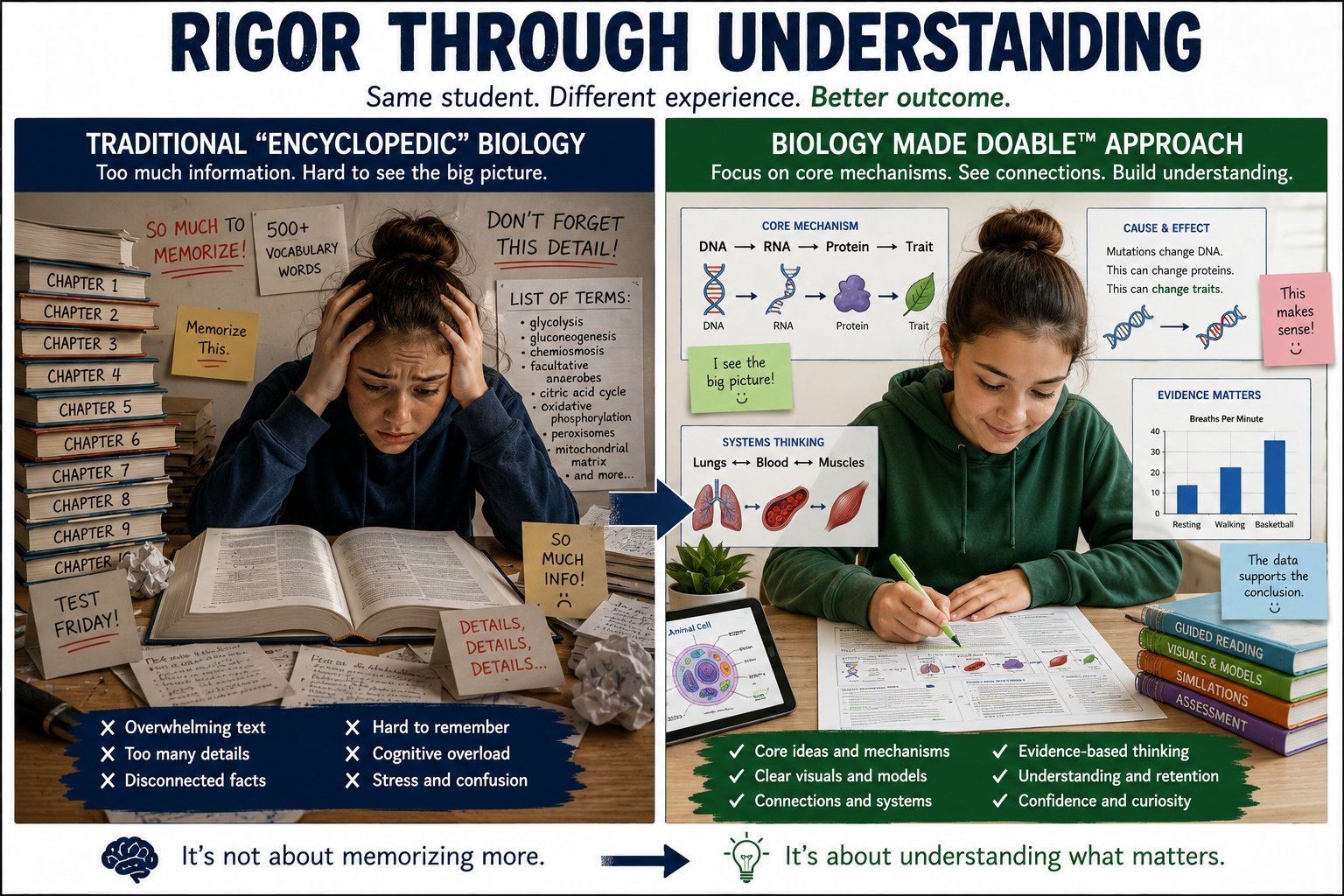
Does rigor in biology come from memorizing more information — or from truly understanding how living systems work?
This article explores why Biology Made Doable™ is moving away from “encyclopedic” biology instruction and toward a model focused on systems thinking, core mechanisms, scientific reasoning, and cognitive clarity. Students do not need endless information overload to experience rigorous science learning. They need structured opportunities to analyze, connect, explain, and think like scientists.
How focusing on core mechanisms helps more students succeed in science
Many people assume that a rigorous biology course must include large amounts of detail, vocabulary, and dense textbook reading. In many classrooms, this leads to lessons packed with information—sometimes more than students can realistically process.
But in recent years, science education standards have begun moving away from this model. The Next Generation Science Standards (NGSS) emphasize something different: helping students understand the core mechanisms that explain how living systems work.
This shift has important implications for how biology is taught.
The Problem With “Encyclopedic” Biology Lessons
In many traditional biology classrooms, lessons are designed to mirror large textbooks. These lessons often include:
long lectures
large amounts of vocabulary
detailed subtopics
heavy note-taking
The goal is usually to preserve academic rigor by covering as much information as possible.
However, this approach can unintentionally create cognitive overload. Students are asked to process large volumes of new information before they have fully understood the underlying concepts.
When this happens, students often fall into a pattern of memorizing facts temporarily, rather than building a meaningful understanding of biological systems.
What NGSS Actually Encourages
The Next Generation Science Standards encourage a different approach.
Instead of focusing on memorizing large amounts of content, NGSS emphasizes three dimensions of science learning:
Core Scientific Ideas
Students should understand the key mechanisms that explain natural phenomena.
Examples in biology include:
how genetic information flows from DNA to proteins
how mutations influence traits
how meiosis creates genetic variation
how natural selection drives evolution
Scientific Practices
Students should learn to:
explain biological processes
analyze evidence
construct models
reason about cause and effect
Crosscutting Concepts
Students should recognize patterns such as:
systems and system interactions
structure and function
cause and effect relationships
Together, these dimensions prioritize conceptual understanding over encyclopedic memorization.
The Biology Made Doable™ Approach
Biology Made Doable™ was designed around this idea.
Rather than overwhelming students with excessive detail, lessons focus on the essential biological mechanisms that explain how life works.
For example, when studying protein synthesis, students focus on the core process:
DNA → RNA → Protein → Trait
Students explore how each step works and why it matters.
Once students understand the mechanism, additional complexity can be introduced more easily.
Reducing Cognitive Overload
Another key principle behind Biology Made Doable™ is managing cognitive load.
Many students struggle in science not because they are incapable of understanding the material, but because they are presented with too much information at once.
By focusing on:
core vocabulary
clear diagrams
step-by-step processes
multiple ways of seeing the same idea
students are able to build understanding gradually.
Structure Matters
Biology Made Doable™ lessons follow a consistent learning pathway that helps students stay oriented and focused:
📊 Concept introduction
📘 Guided reading
🎥 Visual explanation or video
💻 Simulation or activity
💭 Reflection
📝 Assessment
This structure reduces confusion and allows students to concentrate on the science itself.
What Happens in the Classroom
When students learn through this structured approach, several things tend to happen:
Students who normally struggle with dense textbook lessons can follow the learning pathway step by step.
Students who miss school due to sports, illness, or family commitments can recover more easily because the learning process is clearly organized.
Students encounter the same concept multiple times in different formats, helping reinforce understanding.
Most importantly, students begin to see biology as a connected system of processes, rather than a collection of unrelated facts.
Rigor Is Not the Same as Information Volume
One common concern is that reducing encyclopedic detail might reduce academic rigor.
In reality, the opposite is often true.
When students must explain:
why mutations affect traits
how codons determine amino acids
why meiosis creates variation
they are engaging in deeper thinking than simply memorizing terminology.
Rigor comes from reasoning about biological systems, not from the number of vocabulary terms in a lesson.
Biology Should Be Understandable
Biology is one of the most fascinating subjects students encounter in school. It explains how life works—from the smallest molecules to entire ecosystems.
But for many students, the subject becomes overwhelming when it is presented as an endless list of facts.
By focusing on the essential mechanisms that drive life, biology can become both rigorous and understandable.
That is the goal of Biology Made Doable™: helping more students truly understand the science of living systems.

When Language Becomes the First Barrier in Biology
Many students struggle in biology not because the science is too difficult, but because the language of biology is hard to navigate. This article explores how vocabulary-heavy textbooks create barriers and how thoughtful instructional design can make complex ideas easier for students to understand.
Biology is often introduced as the science of life.
But for many students, the first challenge they encounter in biology is not the science itself.
It is the language.
High school biology contains one of the largest vocabulary loads of any subject in the curriculum. Students encounter unfamiliar terms almost immediately: homeostasis, phospholipid, organelle, selectively permeable, cellular respiration.
For students who are developing academic reading skills, this can create a serious barrier before the science even begins.
For bilingual students, the challenge can be even greater. They may be navigating two layers of translation at the same time: everyday English and scientific vocabulary. Even highly capable students can struggle when the reading itself becomes difficult to decode.
The result is something many teachers and parents have seen.
Students begin to skim.
They search for answers instead of reading carefully. They copy definitions into their notebooks without fully understanding them. They memorize vocabulary for a quiz but cannot explain what the words actually mean.
Over time, the subject begins to feel overwhelming.
This is not because students cannot understand biology.
It is often because the structure of the reading materials makes it difficult for them to access the ideas.
The Hidden Design Problem in Many Science Materials
Many traditional biology textbooks are written for advanced readers.
Paragraphs can stretch across half a page. The print is small. Multiple concepts appear within a single section. New vocabulary appears before students have any context for understanding it.
For strong readers, this format may be manageable.
For many other students, it creates cognitive overload.
Students must decode unfamiliar vocabulary, follow complex sentences, and connect new ideas all at the same time. When too many demands are placed on working memory, comprehension begins to break down.
The science becomes lost inside the language.
Designing Biology Materials for Accessibility
One of the lessons many teachers discover over time is that small changes in instructional design can dramatically improve how students engage with scientific reading.
When biology materials are structured carefully, students who previously struggled can begin to understand the concepts much more easily.
Some of the most helpful design elements include:
• introducing vocabulary before the reading begins
• using simplified definitions that explain concepts clearly
• providing visual representations of new terms
• breaking readings into short, focused sections
• using headings and white space to guide the reader
• encouraging annotation while reading
Annotation is especially important. When students highlight key words and write short margin notes, they slow down and begin to process the meaning of the text rather than simply scanning for answers.
Students start to notice relationships between ideas.
They ask questions.
They make connections.
Reading becomes an active process rather than a passive one.
When the Barrier Is Removed
When language barriers are reduced, many students discover something surprising.
They can understand biology.
Students who once felt discouraged begin to complete assignments regularly. They move through lessons with greater confidence. Concepts that once seemed confusing begin to make sense.
This shift often has nothing to do with lowering academic expectations.
In fact, the opposite is true.
When the structure of the material supports reading and thinking, students can engage more deeply with the science itself.
The goal is not to simplify biology.
The goal is to make the ideas accessible so students can build understanding step by step.
Because when students can actually read the science, they often discover that biology is far more interesting than they expected.

Is This Homeschool Biology Program “Dumbing Down” Science — Or Finally Teaching It?
Many parents quietly wonder something when they see a biology course that looks easier to read.
Is it real science… or is it watered down?
The truth is that modern science standards define rigor very differently than many of us experienced in school.
Many homeschool families searching for a biology course eventually run into a quiet worry.
The lessons look clear.
The reading is manageable.
The structure is step-by-step.
And a question appears almost immediately:
Is this real science?
Parents naturally want to make sure their children are learning rigorous biology, not a simplified version of the subject. Choosing a science curriculum feels like an important decision for the future. If a course looks easier to read than traditional textbooks, it’s reasonable to ask whether the academic expectations are still strong.
The answer depends on how we define rigor in science education.
What Parents Are Really Asking About Biology Rigor
When parents ask whether a biology program is “too easy,” they are usually asking something deeper:
Will my child actually understand science?
Is this course legitimate?
Will my student be prepared for future science classes?
Is anything important being skipped?
These concerns are completely understandable. For many families, science has been one of the most frustrating subjects their children encounter. A new course that looks different from traditional textbooks can raise questions about whether it is academically serious.
To answer those questions, it helps to understand how modern science standards define rigor.
Why Hard Textbooks Do Not Equal Real Science Learning
For decades, science courses often signaled rigor through difficulty:
Dense textbook chapters
Heavy vocabulary lists
Fast pacing through many topics
Large amounts of memorization
When students struggled with these conditions, that struggle was often interpreted as evidence that the course was academically demanding.
But difficulty and rigor are not the same thing.
A task can feel hard simply because the structure is confusing, the reading is inaccessible, or the pace is overwhelming. In those situations, students often spend most of their energy decoding the task rather than understanding the science.
Modern science education has shifted away from that model.
What Modern Science Standards Actually Require
Current science frameworks—including NGSS (Next Generation Science Standards)—define rigor differently.
Rigor is not measured by how complicated the reading is.
It is measured by what students can explain, apply, and reason through independently.
Students are expected to:
Explain how structure relates to function
Use models to understand biological systems
Justify patterns and rules using evidence
Connect ideas across readings, diagrams, labs, and simulations
Demonstrate conceptual understanding over time
None of these expectations require unnecessarily complex language.
All of them require thinking.
Why Easier Reading Can Lead to Deeper Thinking
This is where many parents feel uncertain.
If the reading level is accessible, doesn’t that make the course easier?
Not necessarily.
When reading demands are extremely high, students often spend most of their mental energy decoding vocabulary or trying to locate answers in the text. Very little cognitive space remains for reasoning about biological ideas.
When language becomes accessible:
Students spend less energy decoding text
More attention is available for understanding relationships
Misconceptions surface earlier
Students explain ideas in their own words
A sixth-grade reading level does not mean sixth-grade thinking.
It simply means students are not blocked from thinking before they begin.
What Students Actually Do in Biology Made Doable™
In this course, rigor appears in what students are asked to do with biological ideas, not how difficult the text appears.
Students regularly:
Build models of biological structures such as DNA
Explain how structure determines function
Justify why base-pairing rules exist
Compare different types of biological bonds
Transfer ideas across readings, labs, simulations, and reviews
Explain biological concepts in their own words
These tasks cannot be completed through guessing or memorization alone. Students must reason through the ideas repeatedly across different formats.
Understanding becomes unavoidable.
Why This Approach Can Look Different From Traditional Biology
Traditional biology courses often rely on a quiet form of self-selection.
Students who read quickly and comfortably with dense academic language tend to succeed. Students who struggle with reading, pacing, or confidence often fall behind—even when they are capable of understanding the science itself.
When barriers like reading overload, unclear expectations, or rushed pacing are removed, more students reach genuine understanding.
From the outside, that can look easier.
In reality, it means the course is doing its job more effectively.
Instead of sorting students, the design focuses on building understanding step by step.
Support and Rigor Are Not Opposites
Another common misconception is that providing support lowers expectations.
In reality, support removes noise.
Rigor comes from reasoning.
When students are given:
clear structure
manageable reading sections
multiple ways to interact with ideas
opportunities to revisit concepts
they are asked to do something far more demanding than memorization.
They are asked to make sense of biology.
That work requires patience, attention, and repeated explanation.
What Real Biology Learning Looks Like
Real science learning does not always appear dramatic from the outside.
It often looks quieter:
Students reading carefully.
Drawing models.
Analyzing diagrams.
Testing ideas through simulations or small investigations.
But inside that calm environment, something important is happening.
Students begin to:
explain biological ideas without scripts
catch their own misconceptions
transfer understanding across new situations
speak about science with growing confidence
That kind of learning lasts far beyond a single test.
Choosing Understanding Over Survival
When evaluating a homeschool biology curriculum, the most important question may not be:
“Is this hard enough?”
A better question might be:
“Is my child actually learning to think about biology?”
If students are building models, explaining concepts, testing ideas, and revisiting misunderstandings, they are doing real science.
Accessible reading does not reduce rigor.
It removes barriers so reasoning can finally take place.
And when students begin explaining why biological systems work the way they do, the goal of science education has finally been reached.
Related Reading
If you're curious why many students struggle with traditional biology courses, you might also enjoy this article:

Why High School Biology Feels So Hard for Many Students
It All Begins Here
Many students begin high school biology excited about learning how living things work. They are curious about animals, plants, ecosystems, and the human body. Yet for many families, the experience quickly becomes frustrating.
Students often encounter long lists of vocabulary, dense textbook chapters, and complicated diagrams before they have had time to build a clear understanding of the ideas behind them.
Parents may start wondering:
Why does biology seem so difficult when my child enjoys science?
The Hidden Challenge of Biology
Biology is not difficult because students cannot understand it. Biology becomes difficult when students are expected to memorize large amounts of information before they have developed a mental framework for how living systems work.
Many traditional courses introduce dozens of new terms at once. Students may be able to repeat definitions, but they do not always understand how the pieces connect.
Without that structure, biology begins to feel overwhelming.
When Reading Gets in the Way of Learning
Another challenge many students encounter is the reading level of traditional biology textbooks. These books are often written in long, dense paragraphs filled with unfamiliar vocabulary.
Students may spend more time trying to decode the language than understanding the science itself. When this happens, biology can begin to feel like a reading challenge rather than an exploration of living systems.
In Biology Made Doable™, the reading material has been carefully structured so students can focus on understanding the concepts rather than struggling through heavy blocks of text. Ideas are introduced in shorter sections with clear explanations, diagrams, and guided questions that help students process what they are learning.
This approach allows students to build understanding step by step while still learning the vocabulary and concepts expected in a high school biology course.
How Understanding Develops
Real understanding develops gradually.
Students need opportunities to:
• observe biological patterns
• explore visual models
• investigate real processes
• revisit ideas multiple times
When students experience biology in this way, vocabulary becomes meaningful because it describes ideas they have already explored.
A Different Approach
Biology Made Doable™ was designed around a simple principle:
Understanding should be earned through experience, not memorized all at once.
Instead of overwhelming students with large amounts of terminology, the course builds ideas step by step through:
• guided online lessons
• interactive activities and simulations
• hands-on investigations
• structured reflection in the workbook
Students return to important concepts repeatedly so that understanding grows naturally over time.
When Biology Becomes Clear
When biology is presented in a structured and accessible way, many students discover that the subject is far more interesting than they expected.
The goal of Biology Made Doable™ is not simply to help students complete a course, but to help them see how biological systems connect and function.
When that happens, biology becomes something students can truly understand.